📅 Updated: July 2026 | ⏱ Reading Time: 8-10 minutes | Written by Dog Training Experts
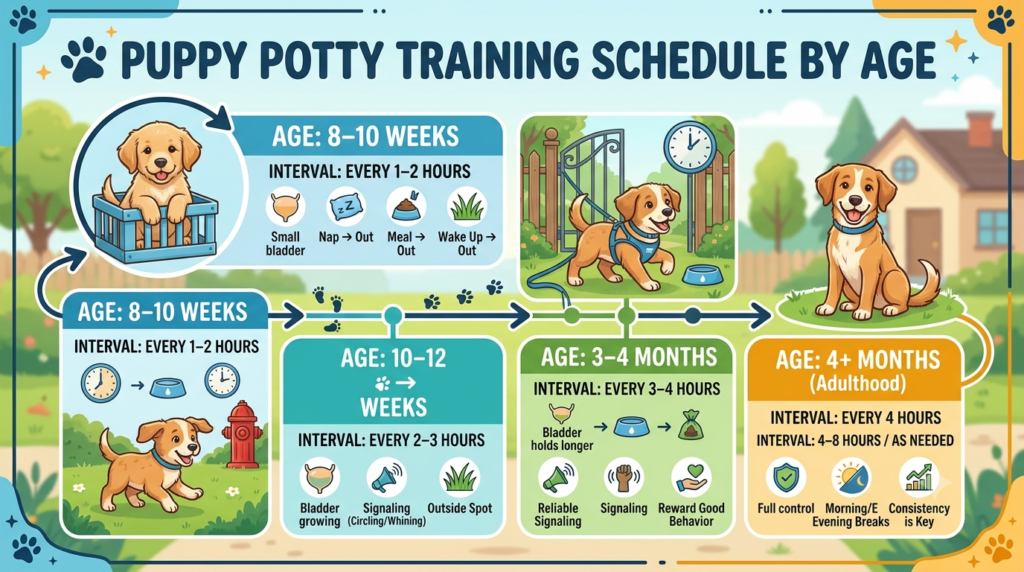
One of the most common questions new puppy owners ask is: “How often should I take my puppy out — and when?” The answer changes as your puppy grows. This complete guide to how to housebreak a puppy gives you a clear puppy potty training schedule by age — from 8 weeks all the way to 6 months — so you always know exactly what to do and when.
📌 Key Takeaways
- Potty training schedules must change as your puppy grows — one size does not fit all ages.
- The golden rule: 1 hour per month of age = how long they can hold their bladder.
- Always take your puppy out after waking, eating, drinking, and playing to ensure success with house training puppies.
- Reward immediately after they go outside — timing is everything in positive reinforcement dog training.
- Never punish accidents — it slows down training, causes fear, and halts progress.
- Most puppies are reliably trained by 4–6 months with consistency.
Why Age-Based Schedules Matter
Most potty training guides give you one generic schedule — but that’s not how puppies work. A 2-month-old puppy physically cannot hold their bladder as long as a 5-month-old. Using the wrong schedule leads to preventing indoor dog accidents becoming nearly impossible and causes frustration for both you and your pup.
The key rule to always remember is:
🐾 1 hour per month of age = how long your puppy can hold their bladder.
So a 2-month-old needs a potty break every 2 hours. A 4-month-old can wait about 4 hours. Simple and easy to remember!
| Puppy Age | Recommended Potty Break Interval | Bladder Development Level |
|---|---|---|
| 🍼 8 Weeks | Every 1–2 hours | Bladder is tiny — expect many trips! |
| 🐾 10–12 Weeks | Every 2 hours | Starting to learn routine. |
| 🐕 3 Months | Every 3 hours | Better bladder control developing. |
| 🦮 4 Months | Every 4 hours | More reliable with good routine. |
| 🐩 5–6 Months | Every 4–6 hours | Almost fully trained! |
| 🏆 6+ Months | Every 6–8 hours | Adult schedule achieved! |
The Biology of a Puppy’s Bladder
Before diving into the schedules, it is crucial to understand the anatomy of a growing dog. At 8 weeks old, a puppy’s bladder is roughly the size of a walnut. Physically, the muscles that control the urinary sphincter are not fully developed until they are about 16 to 20 weeks old.
This means that physical dog bladder control is a developmental milestone. When a very young puppy has an accident inside, they are not doing it to be “bad” or stubborn—they simply do not have the physical capacity or the cognitive muscle connection to hold it. Expecting an 8-week-old puppy to wait three hours is biologically impossible and will set your progress back significantly.
Puppy Potty Training Schedule by Age
Here is your complete, age-by-age breakdown with exactly what to do at each stage:
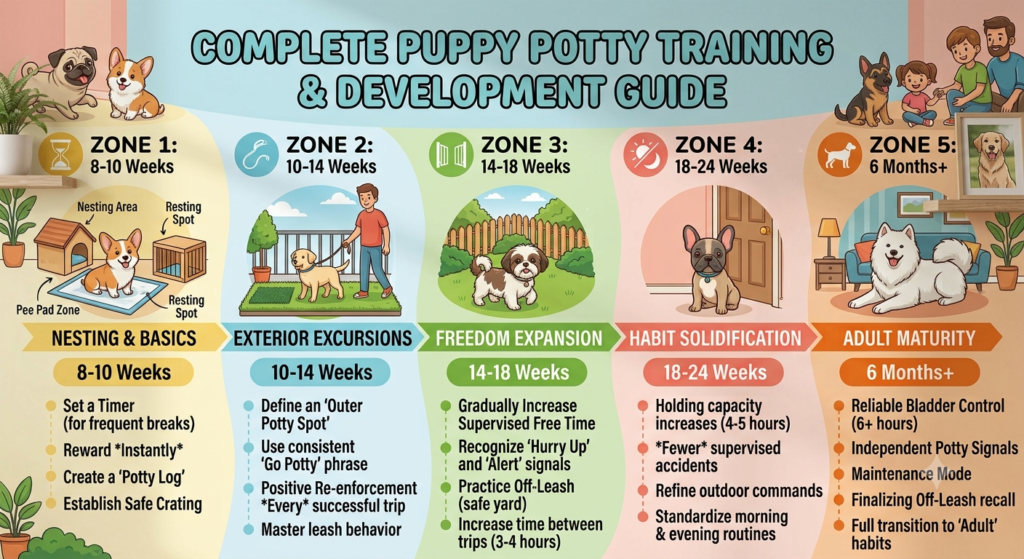
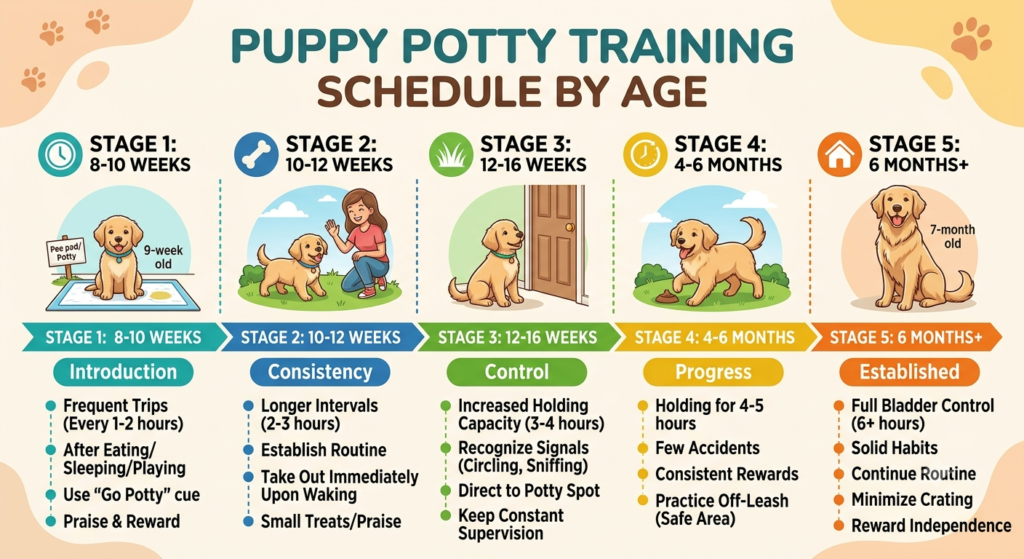
🍼 Stage 1: 8 Weeks Old (2 Months) — Every 1–2 Hours
This is the youngest most puppies come home. Their bladder is extremely small and they have almost no control yet. Expect this to be the most demanding stage — but also the most important for building good habits in house training puppies.
During this stage, your primary goal is to prevent accidents before they happen. Puppies at this age do not have the cognitive ability to associate the physical sensation of a full bladder with the act of going outside until the very last second.
- Take outside immediately after waking up — even from short 10-minute naps.
- Go out within 10–15 minutes after every meal — eating triggers the gastrocolic reflex, which stimulates their digestive tract.
- Take out every 1–2 hours during waking hours — set a physical timer on your phone.
- Take out after every play session — physical excitement increases kidney and bladder activity.
- Take out right before bedtime — empty the bladder completely before crate time.
- Expect 1–2 nighttime trips — young puppies cannot sleep 8 hours straight. Set an alarm for 2:00 AM and 5:00 AM to preempt crying.
⏰ Daily trips: 8–10 times per day minimum
🐾 Stage 2: 10–12 Weeks Old — Every 2 Hours
Your puppy is starting to recognize the routine. They may begin signaling when they need to go — watch for sniffing, circling, or heading toward the door. Keep the schedule very consistent during this critical learning window.
At this stage, you are transitioning from “accidental success” to “learned behavior.” The brain connection is forming, and the puppy is starting to understand that going outside results in high-value treats and enthusiastic praise, which is the core of positive reinforcement dog training.
- Take outside every 2 hours during daytime — consistency is still your strongest weapon.
- Always within 15 minutes of eating or drinking — transition times are highly predictable.
- After every nap and play session — transition from rest to action always requires a trip.
- Right before crate time and after coming out of the crate — integrating a strict crate training schedule builds muscle control.
- One nighttime trip likely still needed — usually around 2:00 AM or 3:00 AM.
- Start using a consistent command word: Say “Go potty” or “Hurry up” exactly as they begin to eliminate.
⏰ Daily trips: 6–8 times per day
🐕 Stage 3: 3 Months Old (12–16 Weeks) — Every 3 Hours
By 3 months, your puppy’s bladder is growing and their control is improving. Many puppies at this age start sleeping through the night without accidents. Keep the daytime schedule consistent and reward every success generously.
This is often the stage where owners get complacent. Because the puppy is doing so well, owners stop watching closely, leading to sudden setbacks. Keep following your crate training schedule to maintain boundaries.
- Take outside every 3 hours during the day — even if they seem like they can hold it.
- Always after meals (within 15 minutes), naps, and play — keep these anchors in place.
- First thing in the morning and last thing at night — establish a clear day-and-night boundary.
- Most puppies can now go through the night — roughly 6 to 7 hours of sleep without needing a break.
- Accidents should be rare — if they occur, re-evaluate your schedule or supervise more closely.
- Continue rewarding every outdoor success — do not phase out treats too early.
⏰ Daily trips: 5–6 times per day
🦮 Stage 4: 4 Months Old — Every 4 Hours
Great progress! Your puppy can now hold their bladder for up to 4 hours as their natural dog bladder control matures. They should be showing clear signals when they need to go, and accidents inside should be very infrequent with a consistent routine.
At 4 months, you can begin to expand your puppy’s freedom within the house. However, this should be done slowly, one room at a time, and only after they have been accident-free for at least two consecutive weeks.
- Take outside every 4 hours during the day — matches their natural biological holding time.
- Morning, midday, late afternoon, and evening trips — fits well with standard human work/school schedules.
- Always after meals, naps, and exercise — these physical triggers still apply.
- Should sleep through the night without accidents — easily managing 7 to 8 hours of sleep.
- Begin giving slightly more freedom indoors — block off uncarpeted rooms first.
- Start phasing out constant supervision — only if they are 100% accident-free.
⏰ Daily trips: 4–5 times per day
🐩 Stage 5: 5–6 Months Old — Every 4–6 Hours
You’re in the home stretch! Most puppies at this age are nearly fully house-trained. They have good bladder control, signal reliably, and accidents should be rare. Keep rewarding good behavior and continue the routine.
By 5 to 6 months, the behavior is nearly automated. However, hormonal changes (especially if your puppy is entering adolescence) can sometimes cause a temporary puppy potty training regression. If this happens, simply drop back to the 4-month schedule for a few days to get back on track.
- Take outside every 4–6 hours — matches the baseline of an adult dog.
- Morning, afternoon, and evening trips minimum — simple three-to-four-times-a-day schedule.
- Always after meals and vigorous play — keep the habit strong.
- Can now be trusted with more freedom in the house — supervise from a distance.
- Continue using command word — reinforces the behavior for life.
- Transition to an adult schedule is almost complete — consistency has paid off!
⏰ Daily trips: 3–4 times per day + after meals
Sample Daily Potty Schedule (3-Month-Old Puppy)
Here is a sample full-day schedule you can follow for a 3-month-old puppy. You can easily adjust the clock times to match your own personal work or sleep routine:
| Time | Event | Action Required |
|---|---|---|
| 7:00 AM | 🌅 | Wake up — Carry or walk your puppy outside immediately before doing anything else. |
| 7:15 AM | 🍽️ | Breakfast — Feed them, then take them outside within 15 minutes of eating. |
| 9:30 AM | 🎾 | Playtime — Engage in interactive play, then head outside immediately after. |
| 10:00 AM | 😴 | Nap in crate — Let them rest. Take them outside the second they wake up. |
| 12:00 PM | 🍽️ | Lunch — Feed lunch and offer water, then head outside within 15 minutes. |
| 2:00 PM | ⏰ | Scheduled potty break — Take them out to their spot even if they don’t show signs. |
| 4:00 PM | 🎾 | Afternoon play — Play session, followed by an immediate outdoor trip. |
| 5:30 PM | 🍽️ | Dinner — Feed dinner, take them outside within 15 minutes. |
| 7:00 PM | ⏰ | Evening potty break — Quick trip outside to keep them empty. |
| 9:30 PM | 🌙 | Bedtime — Last potty trip of the night, then directly into the crate. |
Signs Your Puppy Needs to Go — Right Now!
Learning to read your puppy’s body language is just as important as keeping a schedule. Preventing indoor dog accidents starts with spotting these subtle clues:
- 👃 Sniffing the Floor Intensely: The absolute #1 signal. If your puppy suddenly puts their nose to the ground and starts sniffing with focus, they are searching for a spot.
- 🔄 Circling in One Spot: Puppies circle to align themselves and stimulate their bowels. If you see circling, pick them up immediately and run outside.
- 😢 Whining or Whimpering Suddenly: This is a vocal distress signal showing they realize they have to go but don’t know where to put it.
- 🚪 Heading toward the Door: If they walk toward the exit or stare at the door, they have already associated the outdoors with potty time.
- ⏸️ Stopping Play Suddenly: A puppy that is running around playing and suddenly freezes or walks away to a corner needs a break.
- 😣 Restlessness in the Crate: Whining, scratching at the crate door, or moving around frantically means they are trying to avoid soiling their sleeping area.
Deep-Dive Potty Training Tips for Every Age
To make sure your schedule works seamlessly, implement these proven training habits:
1. The Power of the “Potty Spot”
Always take your puppy out using the exact same door, walking the exact same path, to the exact same spot in your yard. Dogs are highly scent-driven creatures. When they smell their previous eliminations in a specific area, it triggers a natural instinct to go in that same spot again.
2. The “30-Second Reward Rule”
Timing is everything in how to housebreak a puppy. If your puppy goes potty outside, and you wait until you walk back into the kitchen to give them a treat, they will think they are being rewarded for entering the kitchen. You must deliver the high-value treat (like freeze-dried liver or chicken) and high-energy praise within 3 seconds of them finishing their business, while they are still standing on the grass.
3. Crate Training is Your Best Friend
Dogs are den animals. They instinctively try to keep their sleeping quarters clean. By using a properly sized crate (just big enough for them to stand, turn around, and lie down), you utilize their natural instincts to help them build bladder control. If the crate is too large, they will sleep on one side and use the other side as a restroom.
4. Feed on a Strict Schedule
If you leave food out all day (free-feeding), your puppy’s digestion will be completely unpredictable. By feeding them at the exact same times every day, you can predict with almost mathematical certainty when they will need to defecate.
⚠️ Common Mistakes That Stall Progress
Avoid these frequent pitfalls to keep your training on track:
- Giving too much freedom too soon: Many owners let their 12-week-old puppy roam the entire house. This is a recipe for disaster. Keep them in the same room as you, or tethered to you with a leash, until they are completely house-trained.
- Punishing accidents: If you find an old accident on the carpet, do not rub your puppy’s nose in it or yell. They do not have the cognitive ability to connect your anger with something they did hours or even minutes ago. All this teaches them is to fear you, which often causes a sudden puppy potty training regression where they hide in closets or behind couches to go potty in secret.
- Using standard household cleaners: Standard cleaners containing ammonia actually smell like urine to a dog. You must use a specialized enzymatic cleaner that breaks down the proteins in the urine to completely eliminate the scent profile.
- Skipping nighttime trips for very young pups: Expecting an 8-week-old puppy to hold their bladder for an 8-hour stretch overnight will cause physical discomfort and lead to crate-soiling, which is incredibly difficult to train out later.
Frequently Asked Questions (FAQs)
❓ What is the best puppy potty training schedule for an 8-week-old?
At 8 weeks, take your puppy outside every 1–2 hours, immediately after every meal, after every nap, after play, and right before bed. Expect 8–10 trips per day and possibly 1–2 at night.
❓ When can a puppy sleep through the night without a potty break?
Most puppies can sleep through the night (6–8 hours) without a potty break by around 3 to 4 months of age. Before that, expect at least one nighttime trip.
❓ How many times a day should a 3-month-old puppy go potty?
A 3-month-old puppy typically needs to go outside 5–6 times per day — after every meal, after naps, after play, and first thing in the morning and last thing at night.
❓ How long does puppy potty training take?
With a consistent age-based schedule, most puppies are reliably house-trained by 4 to 6 months old. Smaller breeds may take up to a year due to smaller bladder capacity.
❓ What if my puppy is still having accidents after 4 months?
Go back to the more frequent schedule for their age, check that you’re cleaning accidents with an enzymatic cleaner, and consider a vet check to rule out a urinary tract infection. Consistency is key — even a few missed trips can cause setbacks.
❓ Should I wake my puppy up at night to take them out?
For puppies under 3 months — yes, set an alarm for a middle-of-the-night trip. For puppies 3 months and older, wait and see if they can hold it. If they whine or move around in their crate, take them out immediately.
Final Thoughts
Following the right puppy potty training schedule by age is the single most effective thing you can do to make house-training fast and stress-free. The schedule changes as your puppy grows — and that’s completely normal and expected.
Stay consistent, reward every success, clean every accident properly, and be patient. Your puppy is learning something entirely new — and with the right schedule at the right age, they’ll get there faster than you think! 🐾