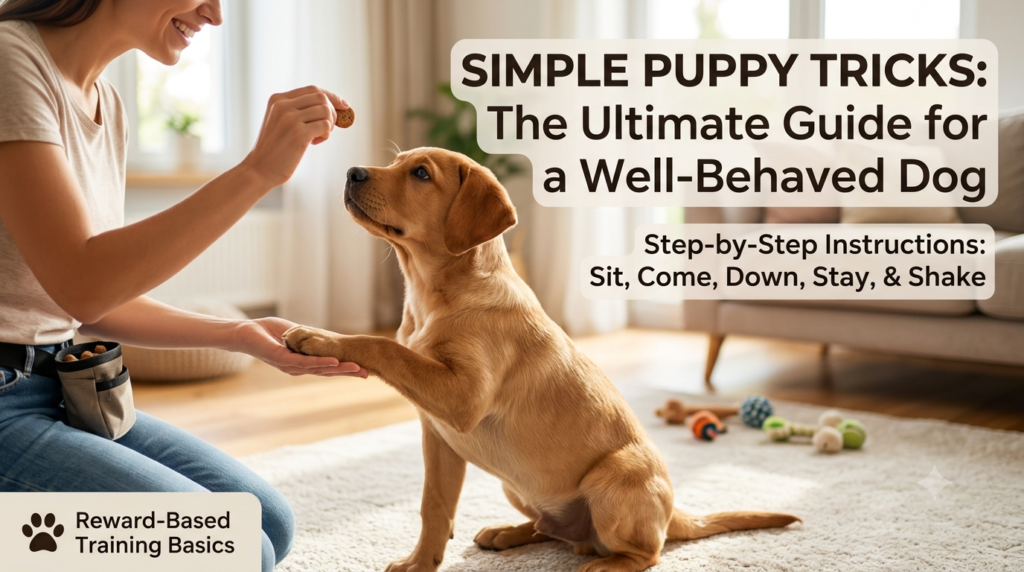
Bringing a new dog into your home is an incredibly rewarding experience, filled with boundless energy, cuddles, and curiosity. As your new furry best friend explores their environment, it is the perfect time to begin their basic education. Teaching simple puppy tricks isn’t merely about showing off to your friends and family; it is a fundamental step in building a strong, lifelong bond, ensuring their safety, and establishing a positive learning atmosphere.
In this comprehensive guide, we will explore the core principles of dog training basics, dive deep into canine psychology, and outline the most effective simple puppy tricks that you can start teaching today. Whether you want to improve their focus or just burn off some extra mental energy, these reward-based training methods will set you and your dog up for absolute success.
How Dogs Learn: The Science Behind simple puppy tricks
To effectively train your dog and ensure a harmonious co-habitation in a human-driven environment, you first need to understand the mechanics of canine learning. Dogs, like most animals, are opportunistic creatures constantly striving for the best possible outcome. They learn primarily through associative learning, which helps them better predict the future and make respective decisions about upcoming events.
Before diving into hands-on simple puppy tricks, it’s vital to grasp the three main ways dogs process information:
A) Non-Associative Learning
This occurs when a dog is exposed to a single stimulus repeatedly. Habituation (getting used to a harmless sound, like a vacuum cleaner) and sensitization (becoming increasingly reactive to a stressful sound, like fireworks) fall under this category.
B) Associative Learning (Classical and Operant Conditioning)
This is the holy grail of successful dog training.
- Classical Conditioning: The dog learns to associate two stimuli. For example, if you always pick up a leash before a walk, the dog will eventually get excited just by seeing the leash.
- Operant Conditioning: The dog learns that their behavior has consequences. If they sit and get a dog treat, they are highly likely to repeat the sitting behavior. Every method used to teach simple puppy tricks should prioritize positive reinforcement—offering a reward that the dog genuinely enjoys when they display a desired behavior.
C) Perceptual and Complex Learning
This involves observation, imitation, and complex problem-solving over time. A mentally stimulated dog adapts to changing circumstances much faster, making them easier to train.
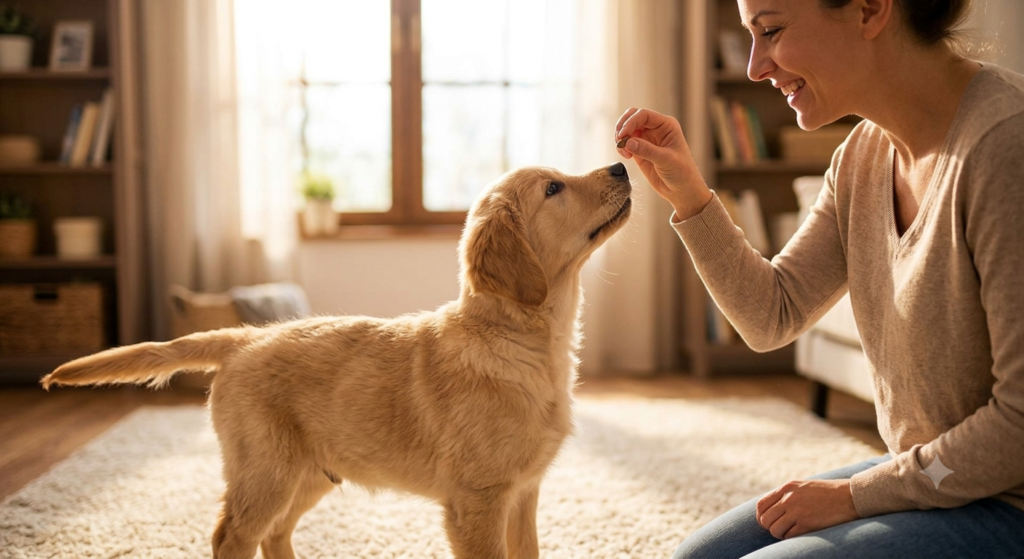
The Golden Rules for Teaching simple puppy tricks
You cannot expect a dog to perform complex maneuvers if the foundation is weak. To successfully master simple puppy tricks, consistency and motivation are your best tools. Just like humans, the stronger the dog’s motivation to attain a specific reward, the simpler it becomes to instill desired behaviors.
Keep these critical principles in mind:
- Consistency and Timing: Dogs live in the present moment. When you are practicing simple puppy tricks, your timing must be impeccable. You have about 1 to 2 seconds to reward a behavior before the dog associates the reward with something else. Furthermore, everyone in the household must use the exact same basic signals and rules.
- Repetition, Practice, and Generalization: Dogs do not automatically generalize. If you teach your dog to sit in the kitchen, they might not know how to sit in the park. You must practice in various environments so they understand the command applies everywhere.
- Motivation and Engagement: Identify what your dog truly enjoys. High-value dog treats, a favorite tug toy, affection, or verbal praise can all be used. Find their favorite rewards and use them to cultivate a highly engaging learning environment.
5 simple puppy tricks You Can Teach Right Now
Once you understand the psychology of positive reinforcement, it’s time for the fun part. Here is a step-by-step breakdown of the top exercises every dog owner should start with.
1. The “Sit” Command
The most fundamental of all simple puppy tricks is teaching your dog to sit. It acts as a transitional command for impulse control and stops unwanted behaviors like jumping on guests.
- Step 1: Hold a high-value treat close to your dog’s nose.
- Step 2: Slowly move your hand up and back over their head, allowing their head to follow the treat and causing their bottom to lower.
- Step 3: Once their bottom hits the floor, say “Sit,” give them the treat, and share verbal praise.
2. The “Come” or Recall Trick
A reliable recall can save your dog’s life. It is the most critical basic signal you will ever teach.
- Step 1: Put your dog on a leash and leash in a quiet room.
- Step 2: Get down on their level, open your arms, and enthusiastically say “Come!” or “Here!”
- Step 3: When they move toward you, gently reel them in, and reward them massively with treats and affection as soon as they reach you. Make sure arriving at your feet is always the best thing in the world.
3. The “Lie Down” Trick
Moving from a sit to a down position is a natural progression, adding to your repertoire of simple puppy tricks while teaching your dog how to relax on command.
- Step 1: Ask your dog to “Sit”.
- Step 2: Hold a treat to their nose, and slowly bring it straight down to the floor, then drag it along the ground away from them.
- Step 3: As they follow the treat, they will slide into a lying position. Say “Down” and reward them immediately.
4. The “Stay” Trick
Unlike other simple puppy tricks, this one requires serious impulse control and patience. It teaches your dog to remain in place until released.
- Step 1: Ask your dog to “Sit” or “Down”.
- Step 2: Open the palm of your hand in front of you, say “Stay,” and take a single step backward.
- Step 3: If they stay, immediately step back to them, reward, and praise. Gradually increase the distance and duration (only change one criterion at a time) over several training sessions.
5. The “Give Paw” or Shake Trick
Once the essential commands are covered, you can introduce fun simple puppy tricks like shaking paws for extra mental stimulation.
- Step 1: Ask your dog to “Sit”.
- Step 2: Present a closed fist with a treat inside. Your dog will likely sniff, lick, and eventually paw at your hand to get the treat.
- Step 3: The exact second their paw touches your hand, open it, say “Shake,” and let them have the treat.
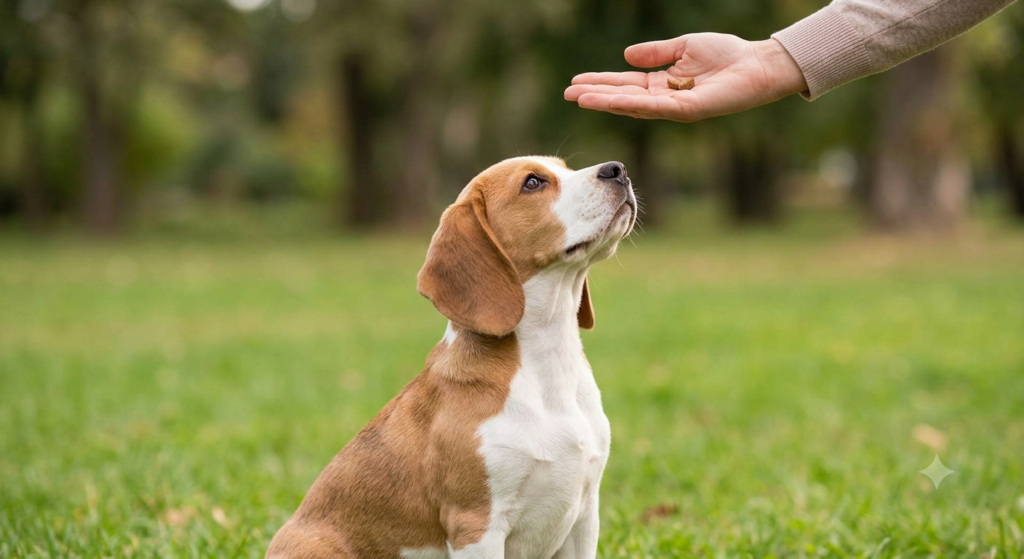
Quick Pro-Tips for Perfecting simple puppy tricks
To guarantee success and avoid frustration, professional dog trainers and dog schools recommend adhering to strict training session guidelines. Perfecting simple puppy tricks requires a structured, positive approach:
- ‘Baby Steps’: Divide the training task into small, highly achievable steps. Never ask for too much too soon.
- Positive Learning Atmosphere: Stay calm, friendly, and motivating. If you feel yourself getting angry, end the session. Frustration is the enemy of progress.
- Training Criteria: Always only change one criterion at a time (e.g., increase duration or distance, never both simultaneously).
- Be Patient: Give your dog time to process and react to the given signal. Don’t repeat the command like a broken record; say it once and wait.
- Step Back: If a training criterion is too difficult and the dog is failing, go back a step and make it feasible.
- Choice: Make sure that the dog always has a choice to participate. Coercion does not build trust.
- Be Predictable: Stay fair to avoid disappointment. If jumping on the couch is banned during the week, it must be banned on the weekend too.
- Variable Reinforcement: As your dog gets better, get away from luring with food every single time. Start rewarding randomly to keep up the motivation and performance level.
- Rituals: Fixed start and end training rituals give focus and a feeling of safety.
- Read Stress Signals: Make sure to properly read your dog’s body language (panting, lip licking, yawning) to avoid exhaustion and sensory overload.
- Training Time: It is much better to have many short (3-5 minute) sessions than one long, exhausting training block per day.
- End on a High Note: Always finish the training session at the best point of performance so the dog remembers the fun they had.
- Have Fun: Remember, dog training should be fun for both sides!
The Long-Term Benefits of Early Training
Training goes far beyond simple obedience. By incorporating these simple puppy tricks into your daily routine, you are providing crucial mental stimulation that tires a dog out just as much as physical exercise. A well-trained dog is much easier to manage during vet visits, walks on a loose leash without pulling, and integrates seamlessly into family life.
Remember that you will always get or be shown the behaviors from your dog that you (consciously or unconsciously) reinforced. Stay consistent, keep your treats handy, and enjoy the incredible journey of raising a brilliant, well-mannered canine companion!